Where the Writing Fits
September always feels like a reset. New classes, new timetables, new routines, and the annual moment of looking at my week and wondering how, exactly, I’m going to fit everything in.
Because writing is only one part of my life.
I teach. I do martial arts. I go to Zumba and Clubbercise, and I’m going to be training as a Clubbercise instructor. My weekends are usually full of family, friends, theatre trips, D&D, scrapbooking and whatever else I’ve managed to enthusiastically agree to. And somewhere in the middle of all that, I write fantasy novels.
This week has been a particularly good example.
I had intended to go to martial arts, but stayed late at work instead, getting printing and equipment sorted ready for the week ahead. On Tuesday, I trained my trainee teachers, something I do every fortnight, and then went to the cinema with family that evening.
Wednesday involved speaking to my project manager about The Dawnshield Order, followed by a double exercise class.
Somewhere in amongst all of that, I chose my book cover, which still feels slightly surreal to write.
I’ve sent over some suggested changes, and I’m now very much looking forward to being able to reveal it properly. There is something strange and exciting about spending so long carrying a book around in your head, then suddenly seeing someone else begin to give it a visual identity.
Friday brought another meeting with my project manager after two full days of teaching, followed by dinner at my in-laws’. Unsurprisingly, I ended the evening asleep in an armchair after valiantly trying to remain conscious.
Today was D&D.
So when people talk about finding time to write, I’m never entirely sure that I actually find it.
Mostly, I fit it in.
Writing in the Spaces Between
I don’t have a particularly glamorous writing routine. There is no carefully curated desk overlooking a beautiful lake. No daily 5am writing session. No ritual involving a particular candle, a fountain pen and exactly the right cup of coffee.
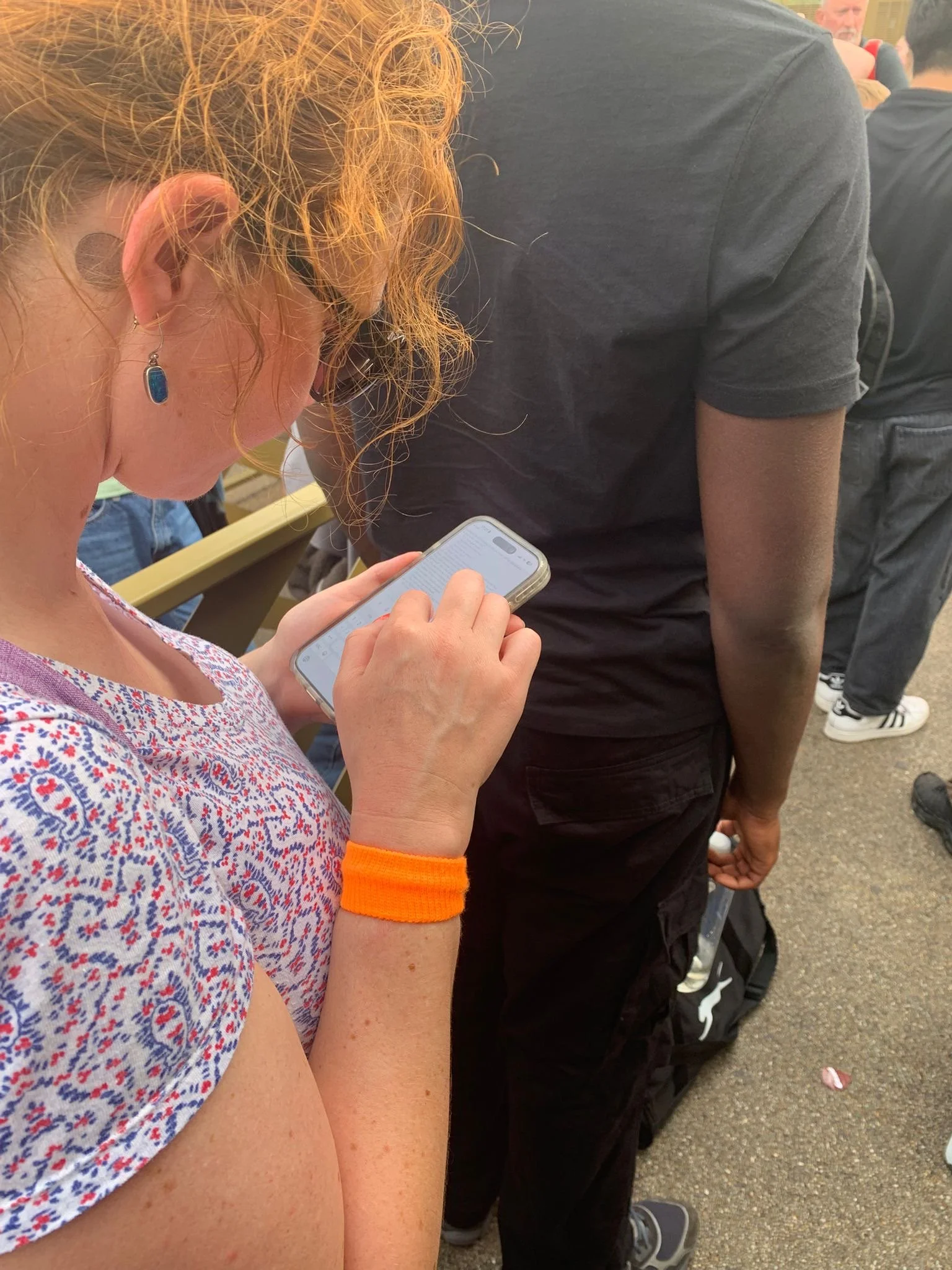
A surprising amount of The Dawnshield Order has been written in the Notes app on my iPhone.
Two days a week, my husband, Ben, drives us to work. We have roughly a fifty-minute commute each way, and those journeys have become incredibly useful little pockets of writing time. I’ll sit there with my phone and write whatever happens to be taking shape: dialogue, pieces of scenes, descriptions, character thoughts or little ideas I don’t want to lose.
Sometimes it is several hundred words of something substantial.
Sometimes I ask myself one apparently harmless question, such as why would Evander react like that?, and somehow emerge three days later having invented several years of his childhood, a formative conversation with his father, a family tradition, an emotionally significant object, the origin of one of his habits and enough historical context to explain a decision he makes in approximately four sentences.
At some point during this process, I usually realise I am no longer fixing the scene.
I am adding to the prequel trilogy.
This was not the plan.
Apparently this is how my brain solves narrative problems: not by answering the question directly, but by excavating half a man’s life until his behaviour finally makes sense.
Then I go back to the original scene, change about four lines, feel extremely pleased that Evander’s reaction now makes perfect emotional sense, and save the other several thousand words in a folder labelled prequel series.
Because Notes syncs with my Mac, everything is waiting for me when I get home. Whenever I have a moment, I move it across into Word and continue working there.
It is not sophisticated, but it works for me.
And I think that has become one of the most important things I have learnt about writing while having a full-time job and a busy life: I cannot always wait for the perfect conditions.
Sometimes I have an hour.
Sometimes I have ten minutes.
Sometimes I have a commute while Ben drives and suddenly realise exactly what Evander ought to say in a scene that has been annoying me for three days.
So I write it down.
When I Get a Proper Stretch
Then there are the times when I get to do the complete opposite.
Friday nights have quietly become one of my regular long writing sessions. Ben heads across the road to my parents’ house to play Agemonia with my cousin, Dad and my sister’s partner — boys’ night — which leaves me at home with the kitten, some popcorn, an apparently endless succession of hot drinks and around five glorious hours in which nobody particularly needs anything from me.
Those evenings are often when I can really disappear into The Dawnshield Order.
Instead of grabbing fragments of dialogue on my phone or scribbling down an idea before it escapes, I can settle in at my Mac, open Word and properly inhabit the story for a while.
Chapters grow. Scenes get rewritten. Continuity problems get untangled.
Sometimes I spend an unreasonable amount of time fixing one conversation because Evander is refusing to say what I need him to say.
The kitten occasionally has opinions about this arrangement.
Mostly involving attempts to climb into the bin or launch a raid on my popcorn.
Sundays can be much the same when I have one genuinely free. Those are the days when I can sit down for several hours and suddenly discover that half the day has vanished because, mentally at least, I have been in Dawnhold rather than at home.
I love those long stretches.
But I couldn’t build my entire writing life around waiting for them, because free Sundays are not guaranteed, and neither is every Friday evening.
Sometimes there is family to see. Sometimes there are friends. Sometimes there is a theatre trip, D&D or something else that has been arranged weeks ago.
Sometimes I simply want to spend the day with my husband, doing something that has absolutely nothing to do with a fantasy novel.
And I’m increasingly comfortable with that.
The Things That Aren’t Writing
I think there is a temptation, when you care deeply about a creative project, to start dividing your life into two categories:
writing
and
things getting in the way of writing.
I don’t think I see it that way any more.
Martial arts is not getting in the way of writing. Neither are Zumba or Clubbercise.
Neither is having dinner with family, going to the cinema, playing D&D, scrapbooking, seeing friends or going to a theatre show.
Those things are my life.
And, perhaps unsurprisingly, they end up feeding the writing anyway.
Martial arts gives me a very physical understanding of movement, balance, fatigue and what the human body can and cannot comfortably do.
D&D lets me play with character and story in an entirely different way, where nobody, including me, knows exactly what is going to happen next.
Theatre reminds me how much can be communicated through dialogue, timing and small pieces of human behaviour.
Scrapbooking is another way of telling stories, just with photographs, paper and memories rather than chapters.
Zumba and Clubbercise give me music, movement, laughter and a couple of hours in which it is extremely difficult to worry about chapter structure because I am too busy trying to remember what my feet are meant to be doing.
And spending time with the people I love gives me the thing I suspect matters most.
A life outside the book.
I don’t really want every spare hour I possess to be converted into writing time.
The things that take me away from the manuscript are often the things that give me something to bring back to it.
Work Is Part of It Too
Teaching has its own rhythm.
There are weeks when everything feels manageable, and weeks when school expands to fill every available corner of my brain.
The beginning of an academic year tends to be one of the latter. There are lessons to prepare, new routines to establish and a hundred small practical jobs that only become visible once everyone is back in the building.
There are also the parts of my job I genuinely enjoy, including working with trainee teachers and helping them develop their own practice.
But teaching uses a lot of the same mental energy that writing does.
Both require you to think about people. Both involve communication. And both involve planning something carefully and then discovering that reality has absolutely no interest in following your plan.
Both can also leave me reaching Friday evening with very little left in the tank.
Hence falling asleep in my in-laws’ armchair.
There are times when work becomes particularly busy and the writing slows down.
I’m learning not to panic when that happens. The books are still there, and the story has not vanished because I went several days without adding to it.
Sometimes the most useful thing I can do is go to work, teach my classes, see people I love, exercise, sleep properly and come back to the manuscript when I actually have something to give it.
Perhaps It Isn’t Balance
People often talk about achieving a work-life balance, balancing work with hobbies, or balancing writing with everything else.
I’m not sure mine ever looks particularly balanced.
There are weeks when teaching dominates.
There are Friday nights with popcorn, a kitten and far too many hot drinks, and Sundays when writing swallows most of the day.
There are evenings when I go straight from work into an exercise class.
There are weekends almost entirely given over to friends and family.
There are journeys where I write a scene on my phone before we have even reached work.
And there are other Friday nights when I fall asleep in an armchair because apparently I have reached the absolute limit of my ability to remain conscious.
Perhaps rhythm is a better word for it.
Different things come forward at different times. The important part, for me, is that none of the things I care about disappear completely.
I keep teaching.
I keep writing.
I keep moving.
I keep seeing people.
I keep making things.
I keep playing.
And somehow, gradually, a novel gets written in the spaces between all of it.
There is no perfect routine behind The Dawnshield Order.
There are phone notes written on the commute, scenes thought through while walking somewhere and ideas written down between other plans.
There are weeks when hundreds or thousands of words appear, and weeks when the achievement is simply keeping the story alive in my head.
And right now, at the beginning of another academic year, I think I’m all right with that.
Writing matters enormously to me.
But so does the rest of my life.
Perhaps the trick isn’t finding the perfect balance between them.
Perhaps it is simply making sure that I keep making room for both.