Last night I was talking to a teacher friend from a completely different school.
Different subject, different department, different leadership team.
Yet as we compared recent experiences, it felt as though we were describing the same person. The details were different, but the frustrations were remarkably similar. It left me wondering why some leaders inspire loyalty while others merely hold authority. And, perhaps unsurprisingly, it also made me think about fantasy.
Fantasy is full of kings, generals, captains, mentors and chosen heroes. Some command armies. Some save kingdoms. Some carry magical swords and fulfil ancient prophecies.
When readers talk about the leaders in fiction, they rarely mention the most powerful characters. Instead, they remember Aragorn, Professor McGonagall and Samwise Gamgee. Not because these characters hold authority, but because of how they treat the people around them.
That distinction has fascinated me for a long time.
As both a teacher and a writer, I've spent years thinking about what makes people trust one another. Why do some people inspire loyalty while others simply hold authority? Why do some leaders bring out the best in those around them while others seem to drain confidence from every room they enter? Those questions eventually found their way into the creation of The Dawnshield Order.
What it truly comes down to is the distinction between authority and leadership.
Authority can be granted, but leadership must be earned.
Someone can hold a title, oversee a department, command an army, or sit on a throne and still fail to inspire the people around them. Meanwhile, others lead without ever seeking recognition because people trust their judgement and believe they genuinely care.
The leaders I've admired throughout my life all seem to share certain qualities:
They listen.
They remain calm when things go wrong.
They develop the people around them rather than simply judging them.
Most importantly, they make people feel safe enough to grow.
They value opinions, even when they don't ultimately agree with them. They understand that listening and agreeing are not the same thing, but that people deserve to feel heard.
They don't ask others to do what they would not be willing to do themselves. They lead by example rather than expectation.
They model self-respect and self-care because they understand that burnout is not a badge of honour. Looking after yourself is not a weakness; it is what allows you to continue looking after others.
They value people fairly and consistently. Not because someone is talented, useful, high-performing, or easy to manage, but because every person has worth.
When I think about the leaders who have had the greatest impact on my life, whether in schools, books, or elsewhere, these are the qualities I remember most.
Not authority.
Not status.
Character.
Teaching has reinforced this lesson for me again and again. I've never been a believer in the "don't smile until Christmas" approach to classroom management. My expectations are high, but so is my belief in the students sitting in front of me.
The classes that challenge me most often become the classes I am proudest of. Eventually, most students realise that I am not going anywhere. I will still be there tomorrow, I will still have high expectations, I will still believe they can do better.
Sometimes they even apologise for talking.
Occasionally they bake cakes.
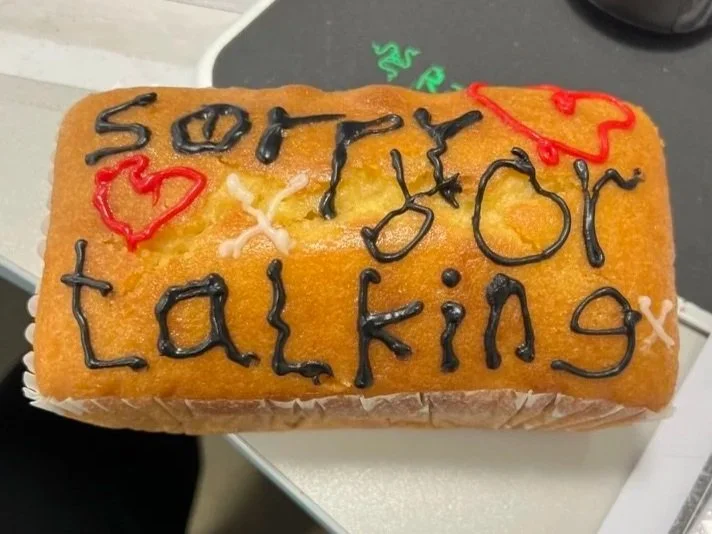
Some of the quiet reminders that trust, humour and high expectations can grow together.
The lesson those students taught me is that respect built through relationships lasts longer than respect built through fear.
One of my favourite teaching memories isn't a set of exam results or an observation grade. It's a student who wrote "Mrs favourite student" across the front of his exercise book. Instead of telling him off for writing on the cover, I simply wrote "True :)" beside it.
The cover eventually found its way into my scrapbook. Not because he was actually my favourite student, but because of what the moment represented. What he was really saying was, "I know you still like me even when I get things wrong."
For me, that trust matters far more than perfect behaviour ever could. Students improve when they know mistakes don't make them unwelcome. People grow when they know failure isn't the end of the conversation.
The best leaders understand that.
One reason I love Professor McGonagall so much is that she embodies this idea perfectly. She has high standards, she expects effort and she can be stern when she needs to be. Yet beneath all of that is a deep belief in her students. She wants them to succeed. That belief changes everything for them.
The same can be said of Miss Honey from Matilda. Neither character leads through intimidation; they lead through care. Their authority comes from competence, consistency and genuine concern for others.
Those ideas shaped two important characters in The Dawnshield Order.
Readers only hear fragments about Thalen early in the story, but he represents the kind of leader I think many of us would willingly follow. He is dependable, compassionate and quietly competent. He inspires loyalty not through fear or status, but through example. Evander learned much of his understanding of leadership from him.
In many ways, Evander reflects my own teaching philosophy. He believes people deserve patience. He believes mistakes should be corrected rather than weaponised. He believes kindness and strength can exist side by side. That doesn't mean he gets everything right. In fact, much of his journey comes from wrestling with doubt, responsibility and the weight of expectations, but at his core is a simple belief that people matter.
Not because they are useful.
Not because they are successful.
Simply because they are people.
When I began creating Evander Drake, I realised I wasn't interested in writing a warrior who inspired obedience. I wanted to write someone who inspired trust. Someone who listened, who carried responsibility seriously, and who would place the wellbeing of others before his own comfort.
The more I developed him, the more I realised that the leaders who inspire me have very little in common with the loudest voices in the room. They are usually the people quietly carrying the weight for everyone else.
Perhaps that's one reason leadership appears so often in fantasy stories. Fantasy strips ideas down to their essentials. Kingdoms rise and fall, armies march, great battles are fought. Yet beneath all the spectacle are ordinary human questions.
Who do we trust?
Who do we follow?
What do we owe one another?
What kind of person do we want to become?
Those questions matter just as much in classrooms, workplaces and communities as they do in fictional kingdoms.
I think that is why fantasy keeps returning to these characters. Not because they are powerful, nor because they are flawless, but because they remind us of something important.
The leaders I remember most aren't the ones who demanded perfection. They're the ones who made people believe they were capable of more.
And if readers find a little of that spirit in Evander Drake, then perhaps some of the best leaders I've known have found their way into Altheryeon after all.